What Is GEO vs SEO and More Businesses Comparing Them?
People often ask which is better between GEO vs SEO because search behavior is changing faster than ever. Traditional search engines still help users discover websites, while GEO can maximize the visibility when appearing in many LLM. In many aspects strategy may be wider scope considering content creation. Instead of choosing your method immediately, it is better to understand both how each serves a different purpose.
Key Takeaways
- SEO and GEO work better together than separately.
- Helpful content builds long-term trust.
- Topic authority beats random publishing.
- User experience supports stronger visibility.
- Trust is the strongest ranking advantage.
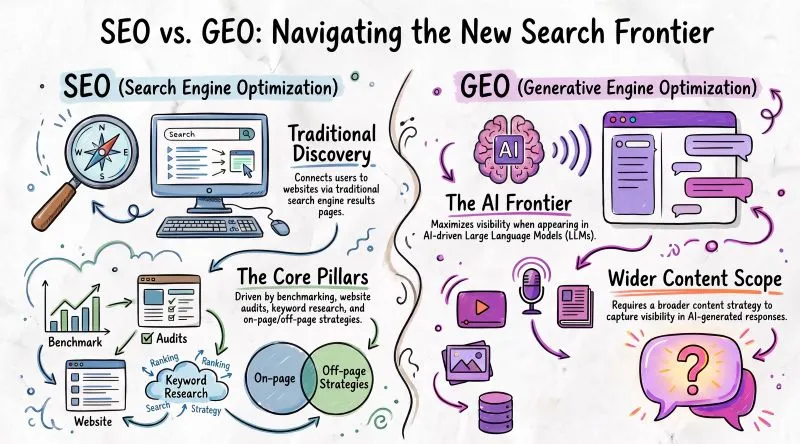
The GEO vs SEO meaning becomes clearer when you look at not the difference but how it is favorable to your content. SEO helps pages appear in search engines while GEO can be achieved by strengthening your traditional fundamentals.According to Google Search’s guidance on creating helpful, reliable, people-first content, useful content should always be written for people before search engines. (Google, 2025) A business that understands both approaches is better prepared to reach customers wherever they search.
Why Has Search Changed So Much in Recent Years?
Technology keeps improving each day and somehow searches evolve in different ways. Many typed short keywords, opened several websites, and compared information before making a decision.Now your users use different outlets to find something and AI assistants complete questions because they want quicker answers.
This change does not mean SEO is dead. Instead, it has created opportunities in a wider platform for businesses that already publish trustworthy information. Business cater or consistently answer real time questions will have an opportunity to GEO.
- GEO – powered by answers
- SEO – powered by organic traffic
Timeline for changes of searches:
2023: The Foundation of “Helpful Content”
2024: Cracking Down and Leaking Secrets
2025: Devaluing Over-Optimized Content
2026: The AI Clean-Up Era
Does Traditional SEO Still Help Businesses Grow
Traditional SEO can be the fundamentals of all search discovery. Imagine a local company that has spent years publishing guides that solve customer problems instead of chasing every trending keyword. Over time SEO can compound and those helpful articles begin attracting visitors who genuinely need the company’s services. Trust grows because the content continues answering questions.
That is the strength of SEO. If you focus on creating pages that search engines can understand while giving visitors a positive experience. Strong website structure, clear headings, fast loading speeds, and useful information continue to support long-term visibility (BrightLocal, 2025).
What Makes GEO Different From Traditional SEO?
GEO or generative engine optimization, focuses on helping AI systems understand and reference reliable information. Both GEO and SEO are the same when it comes to purpose.Rather than optimizing only for rankings, creators also think about how AI models identify trustworthy answers.
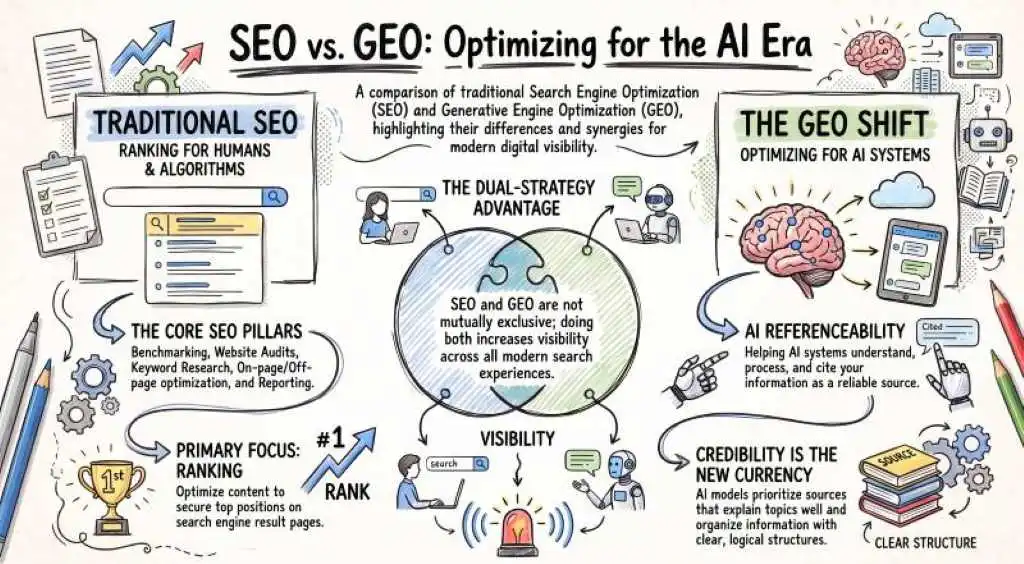
The conversation around GEO vs SEO often highlights that both strategies are doable at the same time. Businesses that target both can be more visible and explain topics well, organize information logically. Credible sources are more likely to earn visibility across different search experiences.
Feature | SEO (Search Engine Optimization) | GEO (Generative Engine Optimization) |
Primary Target | Search engines (Google, Bing) | LLMs & Answer Engines (ChatGPT, Perplexity, Gemini, Claude) |
The End Goal | Rank higher on SERPs to earn a click to your website. | Get cited or mentioned as the trusted source inside an AI response. |
Primary Currency | Backlinks, Domain Rating (DR), and PageRank. | Strong E-E-A-T signals, entity clarity, and brand mentions across third-party platforms (Reddit, G2, etc.). |
Content Structure | Long-form, comprehensive, thoroughly linked topic hubs. | Answer-first execution, standalone context-rich sections, clear H2/H3 hierarchies. |
User Journey | Browsing: Search engines | Prompting: Large Language Model |
Core Success Metric | Organic clicks, impressions, CTR, keyword rankings (tracked via Google Search Console/Ahrefs). | AI Share of Voice, AI Visibility Score, Citation Rate across various prompt models. |
Businesses Benefit From Using Both SEO and GEO Together
Many business owners assume that SEO is better to GEO or they must choose one strategy over the other. In reality, SEO is the fundamentals of your GEO. The strongest online presence often comes from combining proven SEO practices with content that AI systems can easily understand.
- More visibility and outlets of searches
- More traffic and leads
- More sales and profit
A helpful article that answers people’s problems regarding the business. Clear sections, practical examples, and trustworthy references serve both audiences. AI systems prefer to answer questions while search engines drive organic traffic.
Why Does Topic Authority Matter More Than Publishing More Content?
Your idea may be effective when refined compared with sudden massive publishing.Some websites publish hundreds of articles yet struggle to attract qualified visitors which must quality over quantity. Others create fewer pieces but cover one subject deeply, making each article support the next. That difference often explains why one website becomes a trusted resource while another remains difficult to discover.
Instead of writing disconnected posts, businesses benefit from building related content around one central topic. According to Google Search Central documentation on understanding structured data and content quality, well-organized information helps search systems better understand website content. (Google, 2025)
- Google’s AI and Semantic Search Care About Networks, Not Single Keywords: Modern search engines use advanced semantic models to view websites as networks of concepts. If you publish 100 scattered articles on random trending topics, search engines see a shallow footprint. If you publish 10 highly interconnected articles covering every angle of one specific niche, you prove topical competence.
- Efficient Crawl Budget Management: Search engine bots do not have infinite time or resources to crawl every square inch of the web. When you publish massive amounts of thin, low-value content, you waste your “crawl budget.” Focusing on a tightly-knit hub of high-quality pages ensures that bots index your most valuable, traffic-driving assets quickly.
- Naturally Earns High-Value Backlinks: Nobody links to generic, shallow listicles anymore. Digital PR and link-building rely entirely on original data, unique insights, and comprehensive resources. By building deep topical authority, your site becomes the primary source that other writers and AI engines cite, passive-earning links that lift your entire domain’s ranking power.
- Creates a Better User Experience (UX) and Higher Conversions: A user who lands on a site with high topical authority finds a logical journey. They can read a beginner guide, click an internal link to an intermediate deep-dive, and seamlessly transition to a product page. High-volume, scattered content leads to high bounce rates because visitors realize the site lacks real depth.
- Protects You Against Core Algorithm Updates: When Google rolls out Core Updates or Helpful Content Updates, the sites that get decimated are almost always high-volume content mills that rely on programmatic or shallow AI-generated text. Sites built on rock-solid topical authority consistently survive and often thrive during these algorithmic shifts.
How Can Better Content Build More Trust With Both SEO and GEO?
People remember content that solves problems instead of nothing. A business earns trust when it shares the real expertise, experience and clearly explains ideas . Also updates information as searches evolve. That your approach reflects the value of experience, expertise, authority, and trust, which many successful websites practice today.
When you are planning geo vs seo marketing, think about the questions customers ask before they buy. Helpful answers, clear examples, and honest explanations create stronger relationships than content written only to rank. Businesses that focus on helping people first often build lasting credibility. (Search Engine Journal, 2025)
Create Content That Stays Useful Over Time with GEO and SEO
Your content should answer questions that remain important instead of chasing every short-term trend. A useful article can continue bringing visitors months or even years after it is published if it stays accurate and relevant. Regular updates also show that a business cares about providing dependable information.
Search Engine Optimization
- Improves Featured Snippet capture and satisfies immediate search intent.
- Matches Google’s E-E-A-T standards (Expertise, Authoritativeness).
- Keeps users on page longer (dwell time) by cleanly displaying complex info.
- Protects rankings from Google’s Helpful Content algorithm updates.
Generative Engine Optimization
- Allows LLMs to cleanly extract a “chunk” of text to form a direct answer.
- Feeds RAG (Retrieval-Augmented Generation) systems with citable data.
- AI crawlers pull from markdown tables at significantly higher rates than prose.
- Prevents LLMs from treating your information as stale or outdated.
One effective habit is reviewing older articles to improve clarity, remove outdated details, and add new insights when needed. This process strengthens both user experience and search performance without creating unnecessary pages. (Ahrefs Editorial Team, 2025)
Which Strategy Is Better for Long-Term Success?
Your strategy answer depends on your business goals, but choosing only one approach may limit future growth. SEO remains essential because people continue using search engines every day, while GEO helps content become easier for AI-powered search experiences to understand.
When asking geo vs seo what’s the difference, remember that each strategy solves a different challenge. SEO improves discoverability in search results, while GEO increases the chance that AI systems recognize and reference trustworthy information. Businesses that combine both approaches create a stronger foundation than relying on either strategy alone.
Should Businesses Prepare for the Future with GEO and SEO
Search will continue evolving because technology and user expectations never stand still. Instead of chasing algorithms, focus on creating content that answers real questions, demonstrates genuine expertise, and provides a positive user experience. Those principles remain valuable regardless of how people search.
As search continues changing, GEO vs SEO becomes less about choosing sides and more about building trustworthy content that serves every type of search experience.If you want your business to stay visible as search evolves, invest in content that serves people first while following proven SEO and GEO best practices. A thoughtful strategy today can create stronger visibility, better customer trust, and sustainable growth tomorrow.
Frequently Asked Question
What is the difference between GEO and SEO?
The actual difference when executing in discovering searches but in some point it all drives visibility in general.
What does GEO mean like SEO?
It is like navigating the LLM platform while facing another outlet of discovery instead of organic traffic.
What is GEO in digital marketing?
Stands for Generative Engine Optimization and also part of inbound marketing of digital marketing.
What are the key differences between GEO and traditional SEO?
SEO is focused on organic traffic while GEO focusing on AI platforms specially LLM.
Will GEO replace SEO?
No, but it will give more flexibility in any discovering searches.
References
Ahrefs Editorial Team. (2025). How to Create Content That Ranks and Lasts. https://ahrefs.com/blog/
BrightLocal. (2025). Local SEO Learning Hub. https://www.brightlocal.com/learn/local-seo/
Google. (2025). Creating Helpful, Reliable, People-First Content. https://developers.google.com/search/docs/fundamentals/creating-helpful-content
Google. (2025). Google Search Central Documentation. https://developers.google.com/search/docs
Search Engine Journal. (2025). E-E-A-T and Modern SEO Best Practices. https://www.searchenginejournal.com/
Related Post

Recommended Character Count for Meta Description Length

Broken Link Meaning in SEO and Its Impact on Website Rankings